


New analysis of England’s private rented stock by The Mortgage Works, Nationwide Building Society’s buy to let arm, shows that energy performance has become a material driver of rents and asset values as government regulation has shaped the market.
With Minimum Energy Efficiency Standards (MEES) scheduled to require an EPC C rating for all privately rented homes by 2030, landlords, lenders and policymakers all face choices that will shape the future shape and stability of the rental market.
This latest research offers some clear signals about where the market is heading, and where policy and business need to respond.
Uneven progress is being made
Energy efficiency in the private rented sector has improved markedly over the past decade. Just over half (51%) of privately rented homes are now rated EPC C or above, up from just a quarter ten years ago. Newer homes are doing most of the heavy lifting with around 97% of recently built rental properties already meeting EPC C, potentially masking slower progress in older stock.
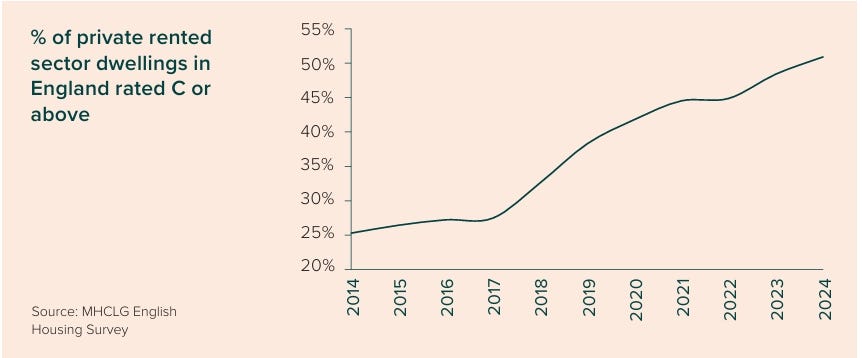
Beneath the headline figure there is significant variation on a regional and property type basis.
London is pulling ahead, with around 65% of PRS homes meeting EPC C or above, reflecting the capital’s higher share of flats and newer buildings.
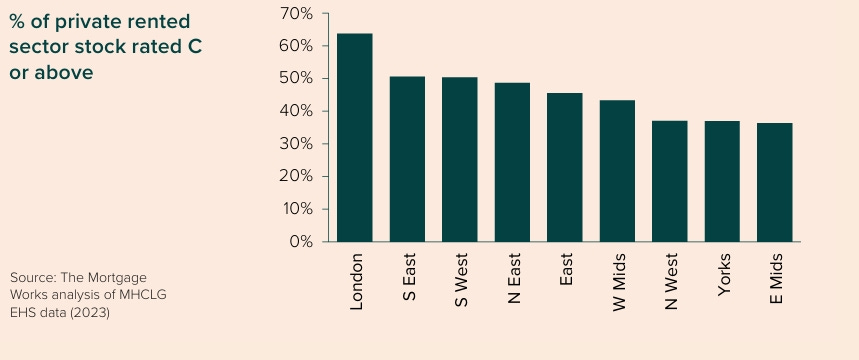
Detached and older terraced houses remain the weakest performers and the most expensive to upgrade. Pre‑1919 homes, which make up nearly a third of the PRS, are the most challenging, with average upgrade costs exceeding £10,000.
This uneven progress matters because regulation is the same across England but housing markets vary by location.
What the market is telling us: Efficiency pays
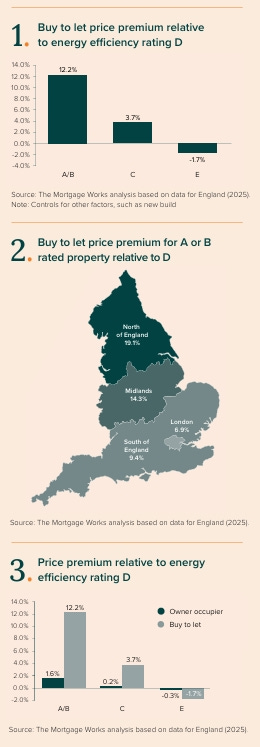
The clearest shift captured in the data is that landlords now price energy efficiency into both rents and purchase decisions. The data shows that rental premiums are rising and compared with an otherwise similar EPC D home:
A or B rated rental properties command an 8.1% rent premium, equivalent to roughly £85 per month on the typical rent in England (£1,075).
C rated homes enjoy a more modest 1.8% premium.
E rated homes increasingly see discounts.
These rental effects are strongest in the North of England, where EPC A and B rated homes deliver rental uplifts exceeding 13%, suggesting that tenants are valuing lower energy bills.
House prices paid by landlords show even more evidence of a price premium for the most energy efficient properties. When landlords buy, energy performance matters even more:
An A or B rated property attracts a 12.2% purchase price premium compared with a D‑rated equivalent
C rated homes still see a positive premium
E rated stock trades at a discount
This differs significantly from the owner occupier market. For someone buying a home to live in, the premium for an A or B rating is just 1.6%. For professional investors, energy efficiency is clearly being treated as an important factor in investment decisions.
Do improvements make financial sense for landlords?
The answer depends heavily on what type of property and where it is.
In much of the Midlands and North, the combination of modest upgrade costs, growing rental premiums, and higher price uplifts means landlords can often recoup the cost of moving from EPC D to C within five years.
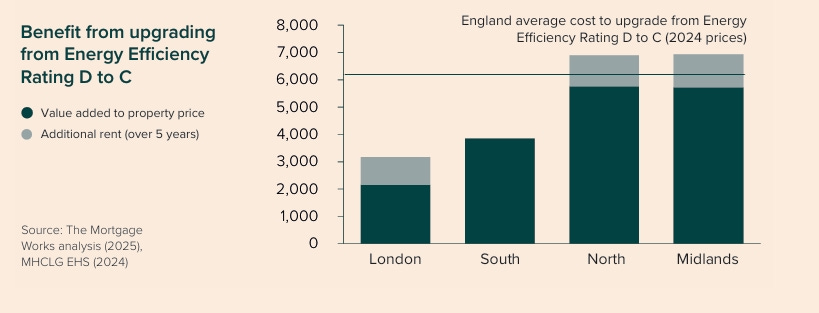
In London and parts of the South, the picture is less compelling. Upgrade costs are higher, rental uplifts smaller, and capital value benefits weaker. Purely on financial terms, many landlords in these regions struggle to justify investment until regulation forces their hand.
What this means for Government
Government has consulted on the MEES rules and has already made adjustments to requirements on landlords. There will be a single implementation date of 2030 for all properties to have a minimum EPC C rather than 2028 for new tenancies and 2030 for existing tenancies. The proposed cost cap on landlords has also been reduced from £15,000 to £10,000. This will mean that once a landlord has spent £10,000 on improvements they will be able to apply for an exemption certificate which means they won’t have to do any more work.
Government should continue to review the following as they implement the requirements:
1. Examine how a national MEES framework fits with regionalised housing markets
Specific national requirements, most notably the £10,000 cost cap, do not take into account the regional nature of the UK housing market. While £10,000 might seem a reasonable amount for more expensive properties in London and the South East it could be a significant proportion of a property’s value in parts of the North.
Government should consider regional cost caps which more accurately reflect different regional markets, property values and landlord’s ability to spend
2. Target support where the market alone won’t deliver
The market is already upgrading homes where returns exist. Government intervention should focus on properties which are mor difficult to improve including older homes, listed buildings and property types least able to self‑finance improvement. This could include time limited grants schemes or tax relief for hard to improve homes.
3. Understand the impact of badly implemented policy on supply and rents
Landlords are adapting to significant regulatory and legislative changes, particularly as MEES comes alongside the reforms in the Renters’ Rights Act. Ensuring these positive changes are implemented by landlords in a way that can be easily understood and comes at reasonable cost will retain good landlords in the sector. Badly implemented regulation mean more landlords leave the market, reducing availability for renters and increasing rents.
Ensuring plenty of good quality energy efficient homes to rent
The evidence from this research is clear and shows that energy efficiency is no longer a marginal consideration in the private rented sector. It is shaping rents, influencing investment decisions and increasingly determining which homes remain viable as long term rental properties. Progress has been real and meaningful over the past decade, but it has also been uneven, reflecting the age, type and location of England’s rental housing stock.
With MEES set to require EPC C across the sector by 2030, the challenge is no longer whether to improve energy efficiency but how to do so in a way that maintains supply, supports affordability and keeps good landlords engaged in the market. Policy that recognises regional variation, targets support at the hardest‑to‑improve homes, and is implemented clearly and proportionately alongside wider rental reforms
The transition is underway. How smoothly it unfolds is a choice still very much on the table.